
The Ports of the Carrera de Indias: Sanlúcar de Barrameda

Author: Jerry Zamora

In Sanlúcar, a river becomes the sea, and the sea turns into a river…

Here, where for centuries, thousands of adventures began. Here, where the most daring feats set sail… From this very place, the world was discovered, circumnavigated, and cultures met.

From here, along the path of the Carrera de Indias—of global trade, maritime adventure, and seafaring hope—Spain rose to greatness.

But today, consigned to oblivion, silent and fearful, perhaps ashamed of having been great… the mouth of the Guadalquivir guards its stories in silence.

Now, when I think upon it, I see ghostly galleons drifting through the air along the river’s course. They sail, floating in the ethereal space of a time long lost…

From the Americas they come, to Seville they go…

From Sanlúcar, others depart—to brave the open sea.

One of Humanity’s Greatest Feats, with Sanlúcar as its Witness.

On 20 September 1519, five ships—Trinidad, San Antonio, Concepción, Victoria, and Santiago—set sail from Sanlúcar de Barrameda, under the command of the Portuguese-born, naturalised Spanish captain, Ferdinand Magellan. A crew of 247 men from ten different nations embarked on a daring quest to find the Spice Route.Three years later, following the most epic voyage in human history, 18 survivors returned to Sanlúcar aboard the Victoria, now under the command of Juan Sebastián Elcano. It was 6 September 1522.“…and this voyage undertaken by that ship was the greatest and most extraordinary thing seen since God created the first man.” — Antonio de Herrera, General History of the Deeds of the Castilians on the Islands and Mainland of the Ocean Sea, 1601.The remarkable map drawn by Battista Agnese, preserved in the National Library of Spain, beautifully traces the route of these giants of world history.For a detailed account of this extraordinary journey, we highly recommend visiting: 🔗 https://www.rutaelcano.com/la-primera-vuelta-al-mundo

The First Japanese Ambassador to Europe

Hasekura Tsunenaga (支倉六右衛門常長)

The samurai Hasekura Tsunenaga was the first envoy ever sent from Japan to Europe. After a stopover in the Viceroyalty of New Spain, his embassy arrived in Sanlúcar de Barrameda on 5 October 1614, causing a great stir in the city due to the exotic nature of the expedition.The Japanese delegation stayed in Sanlúcar for 16 days, drawing particular attention for their unique way of eating—they did not touch food with their hands but used small wooden sticks.The expedition continued to Seville and from there travelled to Madrid, where they were received by King Philip III of Spain. They later proceeded to Rome for an audience with Pope Paul V.On their return to Spain, and once back in Sanlúcar, several members of the Japanese delegation chose to remain in Seville, Coria del Río, and Espartinas, likely giving rise to the surname “Japón”, still found in the region today.The Japanese embassy finally departed from Sanlúcar on 9 July 1617, sailing with the New Spain fleet under the command of General Juan de Salas y Valdés.

San Francisco the Old

The American Territory in Sanlúcar de Barrameda

In the 16th century, the process of evangelising the vast Indies led to a flood of requests from religious men wanting to serve as missionaries in the New World.

By this time, Sanlúcar de Barrameda had already become a true convent city, where thousands of clergy gathered, waiting for the departure of the fleets. However, as they often had to wait for months, sometimes more than a year, before they could embark, it was necessary to support all these idle people.

Through the convents, patronages, alms, and charity, it was a struggle to house and sustain so many religious people in one place. So much so that the Franciscan Order of Andalusia made an unprecedented decision: to segregate the convent and its lands from the order in Andalusia and have it directly fall under the jurisdiction of the Franciscan Province of the Indies. Thus, the Convent of San Francisco el Viejo would legally become part of the American territories, a property of the order in the Indies, and managed by the order in the Indies.

For more information, visit our friends’ website: http://www.fundacionpuertadeamerica.org/

The Bar of Sanlúcar: Graveyard of Mariners

The Bar of Sanlúcar can be described as a kind of reef at the mouth of the Guadalquivir River, where sediments and mud carried by the river settle, complicating navigation. To cross it, a practical river pilot—known as the pilot of the Bar—was required. The ship pilots had to make three sharp “S” turns through a narrow navigable channel to avoid the Bar, a manoeuvre that could only be done under favourable weather conditions, with wind at their backs, and by taking advantage of the high tide.

Waiting for the high tide to gain more depth was not ideal either, as the exhausted fleets arriving from the Indies ran the risk of being attacked by privateers or caught in storms.

Between 1503 and 1650, 9% of ships between the river and the bar were wrecked.

Despite this, the channel still had insufficient depth for the increasingly larger galleons, which grew from 500–600 tons to 900 tons. This ultimately led to the transfer of the Casa de la Contratación from Seville to Cádiz.

In the image, part of an anonymous 18th-century painting depicting the Bar.

Then, a little further in,

It comes to meet them all.

Always that ungrateful bar,

Which has cast so many silver bars

Into the deep centre.
Fray Pedro Beltrán -17th Century

Who were the Lemanians of Sanlúcar?

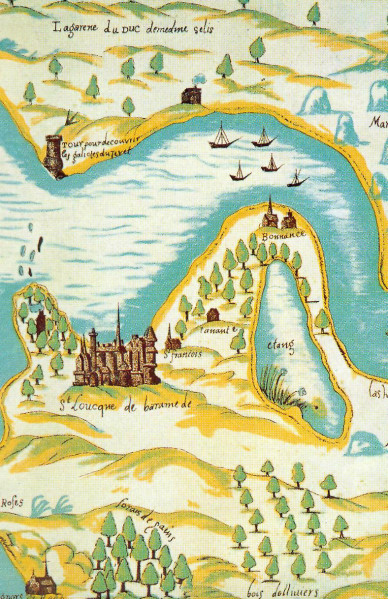
The practical river pilots, pilots of the Bar, or Lemanians of Sanlúcar, were those who knew the river best. They were familiar with the spots where ships had sunk, the currents, the tides, and other “quirks” of the Guadalquivir River. They were the ones who boarded the ships of the Carrera de Indias to help them navigate such a terrible obstacle.There were few of them, and they charged what they demanded. In 1514, they were required to guide the ships of the Great Armada of Castilla del Oro, commanded by Pedrarias Dávila. It is documented that Juan López and Diego López were paid 1000 maravedís for guiding two ships, while Antonio López, Antonio Mateos, and Juan de Morón each received 750 maravedís.A few months later, Juan de Morón was paid 205 maravedís for guiding two leaded caravels from the same fleet to Sanlúcar, assuming that the lemán piloted from the first ship, which served as a guide for the others. The data is extracted from the book Sevilla y las Flotas de Indias, la Gran Armada de Castilla del Oro by María del Carmen Mena García. The image is a drawing by Samuel de Champlain, founder of the city of Quebec in Canada, who was in Sanlúcar in 1599 as a member of a fleet heading to New Spain.
© 2025 MUCAIN ® – Museo Carrera Indias