The First Globalization
This map, created by Ktrinko, can be found on Commons under the name Eckert4.
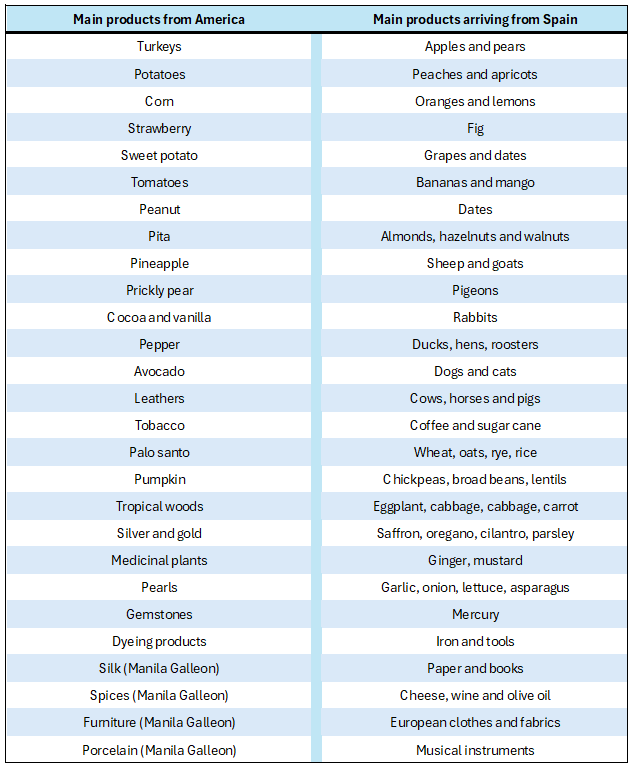
After the discovery of the Philippines, the American route was joined by products arriving from Manila to Acapulco via the Manila Galleon, a route we invite you to explore. With the joining of both routes, the first globalisation was established.Thus, Spain organised a communication network from Seville that, for the first time in history, took on planetary dimensions. Additionally, between 1580 and 1640, Portugal entered into a dynastic union with Spain, making the Hispanic monarchy the absolute ruler of the oceans.
A cosmopolitan city: Seville, gateway and port of the Indies.

View of the City of Seville. Author: Alonso Sánchez Coello from the late 16th century, and is owned by the Prado Museum.
The newly discovered lands required all kinds of goods, and foreign merchants quickly settled in Seville. People from France, Germany, Flanders, the Netherlands, England, Italy, Portugal, and even Sweden, Russia, and the Ottoman Empire became naturalised Castilians or traded with the Indies through Spanish agents.
On the sandbanks of Seville, goods arriving from all corners of the world are loaded and unloaded. The great Lope de Vega y Carpio, the phoenix of poets, perfectly describes this in this excerpt from “El Arenal de Sevilla”:
A Commercial Revolution Without Precedents
A Sea of Sails (I)
A Sea of Sails (II)
“After the disaster of the so-called Invincible Armada, the decline of Spain and the rise of Great Britain began…” Are you sure?
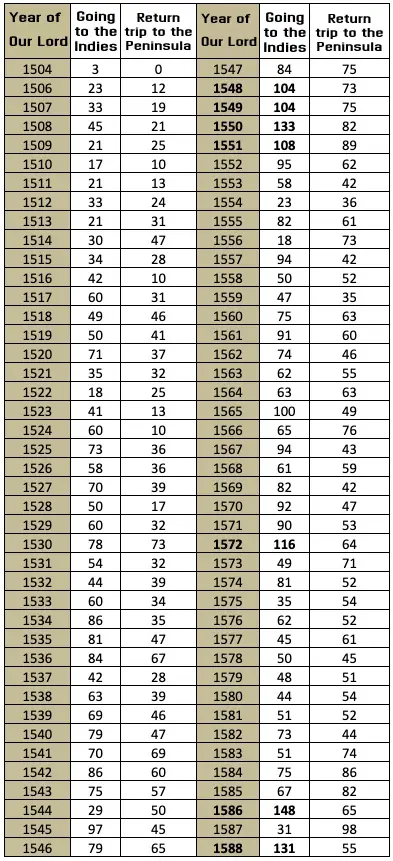
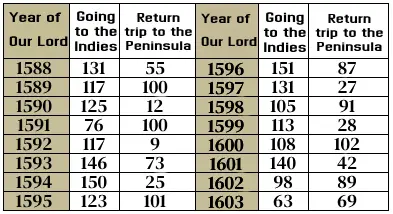
We have all heard at some point about Philip II’s Great Armada against England in 1588 and the terrible disaster it supposedly was… It was indeed a disaster, especially for those who lost their lives in that fateful expedition. However, the following year, the English Counter-Armada suffered an even greater defeat, and Spain ultimately won the war.
We have also always been told that a huge number of ships were lost and that Spain’s unquestionable naval supremacy began its decline… nothing could be further from the truth. In the accompanying chart, it is clear that, after the so-called naval disaster, the number of ships sailing the Carrera de Indias route not only did not diminish but actually increased considerably compared to previous years.
Of all these ships, between 10 and 20 per cent were the famous and powerful galleons that escorted the merchant vessels.
The Fairs and the Arrival of the Fleets
The return journey and the "triangle of death"
The effectiveness of the Carrera de Indias
The End of an Era
The system of the Carrera de Indias was suppressed in 1828 during the reign of Ferdinand VII. In 1869, the Suez Canal opened, and the world began to connect through new routes.
Let me know if you’d like any adjustments!