From the very beginning of the American adventure, Cádiz rivalled Seville for control over transatlantic trade. This rivalry was settled in 1717 when the Casa de la Contratación was transferred from Seville to Cádiz, propelling the city to become one of the most powerful and opulent commercial hubs in Europe. The wealthy *cargadores a Indias* (merchants trading with the Indies) began constructing watchtowers atop their stately homes—structures that would become iconic features of Cádiz’s skyline. In the model of the city housed in the Cádiz Museum, created in 1777, up to 160 of these towers can be counted, with around 130 still standing today.
Information has always equated to power, and every merchant was eager to know not only when their ships departed but, more crucially, when they were returning from the Indies. To this end, lookouts were stationed in the towers, scanning the horizon with telescopes in anticipation of the first sight of approaching vessels. Each tower bore a distinctive flag, allowing ships to identify them from afar. Secret codes using mirrors and signal flags conveyed vital information about the cargo on board.
Recognising one’s own ship—or that of a rival—from the towers was akin to having insider information on the stock market today. Knowing which ships were arriving and the goods they carried enabled merchants to speculate on commodity prices, securing fortunes for some… while causing devastating losses for their competitors.
Own Image Taken from the Tavira Tower
With its 45 metres, the Tavira Tower is the tallest. La Bella Escondida is the most beautiful.
It is worth noting that these towers are not exclusive to Cádiz. Fuelled by the immense trade with the Indies, El Puerto de Santa María also featured these striking structures.
The Dutch Gazettes
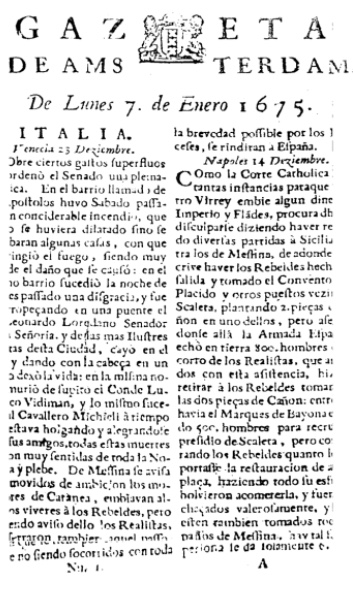
At the beginning of the 17th century, Amsterdam was a hub of printing houses and bookshops, becoming one of the main centres of European intellectual life. All kinds of books were published, along with a type of newspaper known as Gazettes. The renowned Dutch Gazettes reported on a wide range of news, though many of their articles were aimed at merchants. A key event they covered, which impacted the entire European economy, was the departure of the Carrera de Indias fleets from the Americas. They provided the latest available information, including details about the amount of silver on board. This figure was always higher than the silver that eventually arrived in Seville or Cádiz, as part of it came from foreign trade conducted in the Indies, loaded onto foreign ships in the Bay of Cádiz.
There were even gazettes written in Spanish, such as the *Gazeta de Amsterdam*, published by the Dutch Sephardic community between 1675 and 1690, and the *Noticias Principales y Verdaderas*, which appeared in Brussels between 1685 and 1704.
A prosperous, wealthy, cultured, enlightened, and cosmopolitan city
Routes taken by the Malaspina-Bustamante expedition. Property of Iván Hernández Cazorla, Wikimedia Commons (CC-BY-SA 4.0 License).
Thanks to the vitality of trade, Cádiz became one of the most prosperous and advanced cities in the world during the 18th century. Its port became the crossroads where goods from America, Europe, Asia, and Africa converged.
The Enlightenment ideal and all branches of knowledge, the arts, and progress had Cádiz as their epicentre. Scientists, doctors, engineers, military personnel, geographers, artists, cosmographers, botanists, musicians… populated its streets upon returning from the Indies or waiting to embark there, while merchants built beautiful palaces showcasing their power.
It was the time of great scientific and humanitarian expeditions, the golden age of botany, mineralogy, geodesy, and medicine. It was the time of Jorge Juan, Malaspina and Bustamante, Celestino Mutis, Juan de Cuéllar, Antonio de Ulloa, Balmis, Hipólito Ruiz, José Pavón, and so many others who expanded the boundaries of knowledge to previously unknown horizons.
"Havana is Cádiz with more black people..."
Cádiz, Havana with more charm…
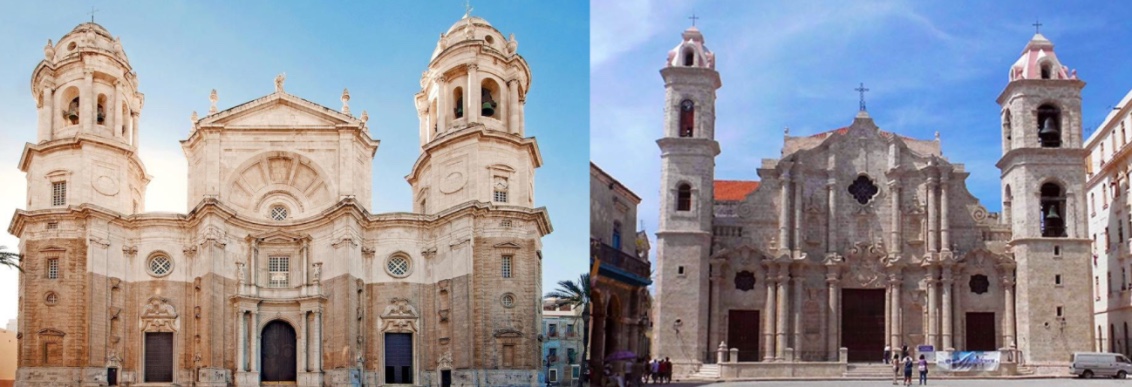
Thus goes the famous habanera by Carlos Cano. And he is not wrong. On the left, the Cathedral of the Holy Cross in Cádiz, on the right, the Cathedral of the Immaculate Conception in Havana.
The two cities are not only similar because of their cathedrals. Anyone who has walked through the historic centre of the Caribbean city, along its seafront, and also through Cádiz and its own seafront, will get the impression that, despite being thousands of kilometres apart, they resemble each other. No wonder, all the key ports of the Carrera de Indias—Cádiz, Havana, Portobelo, Manila, Callao, etc.—were fortified and constructed following the same patterns.
This will be explored in much more detail in the Carrera de Indias room in Stone, the fortifications.