What was the Carrera de Indias?

In this video, you will be able to enjoy the author’s extensive knowledge of the spectacular and unprecedented movement known as the La Carrera de Indias.

The First Globalization

This map, created by Ktrinko, can be found on Commons under the name Eckert4.

The Spanish “Carrera de Indias” was the longest-lasting, most effective, decisive, and successful naval operation in the history of humanity and one of the greatest commercial monopolies ever. It was a system of navigation and exchanges—commercial, cultural, social, and of all kinds—between Spain and the Indies, from the founding of the House of Trade in 1503 until the closure of free trade in 1828.

After the discovery of the Philippines, the American route was joined by products arriving from Manila to Acapulco via the Manila Galleon, a route we invite you to explore. With the joining of both routes, the first globalisation was established.Thus, Spain organised a communication network from Seville that, for the first time in history, took on planetary dimensions. Additionally, between 1580 and 1640, Portugal entered into a dynastic union with Spain, making the Hispanic monarchy the absolute ruler of the oceans.

A cosmopolitan city: Seville, gateway and port of the Indies.

View of the City of Seville. Author: Alonso Sánchez Coello from the late 16th century, and is owned by the Prado Museum.

On paper, only the Castilians had the right to trade with the Indies, but very early on, this privilege was also granted to those naturalised as such. This allowed the city of Seville to become the main commercial hub of Europe.

The newly discovered lands required all kinds of goods, and foreign merchants quickly settled in Seville. People from France, Germany, Flanders, the Netherlands, England, Italy, Portugal, and even Sweden, Russia, and the Ottoman Empire became naturalised Castilians or traded with the Indies through Spanish agents.

On the sandbanks of Seville, goods arriving from all corners of the world are loaded and unloaded. The great Lope de Vega y Carpio, the phoenix of poets, perfectly describes this in this excerpt from “El Arenal de Sevilla”:
What is most praiseworthy is to see so many different nations coming out from these ships; The things that are disembarked, the coming and going of them, and then returning to them with many others that embark;The French bring knives, mercery and from Rouen, the German brings oil. The cloth, fustian, and taffeta he brings…, The wine from Alanís he loads;Iron is brought by the Biscayan, quarter-sawn timber, oxen, pine; The Indian brings ambergris, pearls, gold, silver, Campeche wood, leather…; All that sand is money.

A Commercial Revolution Without Precedents

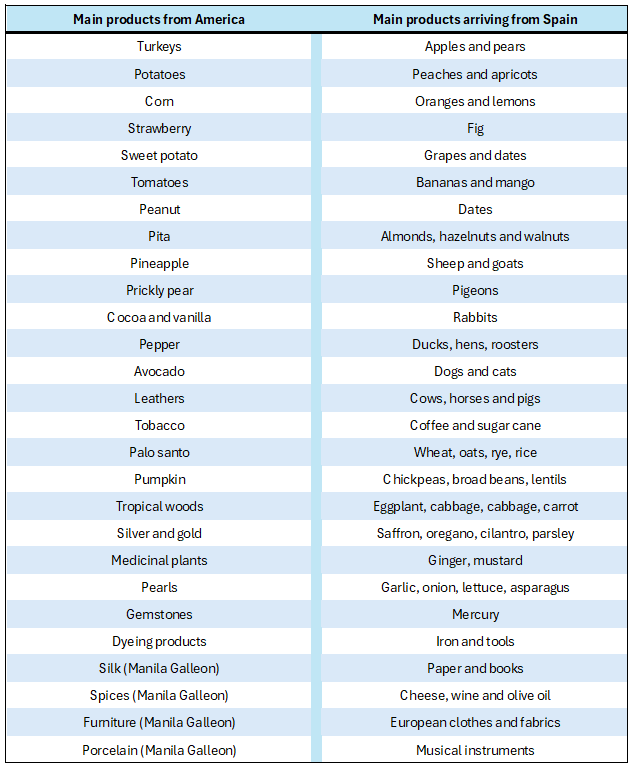
The Carrera de Indias was such an exuberant trade route that when it reached port, inflation would rise… across much of Europe.So effective that throughout its nearly 300 years of existence, only about 1% of its ships were captured or sunk by corsairs or enemies of the crown.So successful that even today, on the other side of the world, we live with products transported in one direction or another in its holds: cereals, vines, sugar, coffee, pigs, cows, sheep, chickens, horses in one direction; turkeys, potatoes, tomatoes, maize, cocoa… in the other.

A Sea of Sails (I)

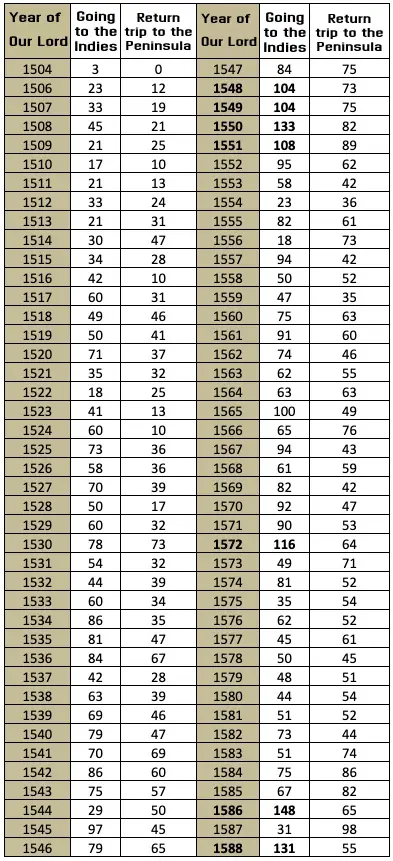
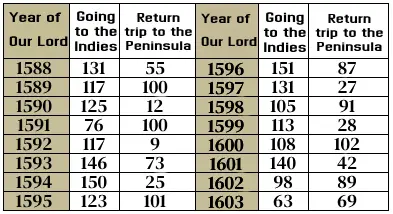
Over several years, more than 100 ships set sail for the Indies.The sight of the sea filled with sails must have been truly awe-inspiring, as was the challenge of guiding such a vast number of vessels into port—each with differing speeds and ways of navigating.
(Cuadro elaborado por Pierre Chaunu)

A Sea of Sails (II)

It was an extremely complex naval and commercial system which, although not perfect, was thoroughly prepared and regulated by meticulous laws and royal decrees—the most advanced of its time.One must consider the extraordinarily difficult logistics required to set sail for the other side of the world: ships had to be readied, goods prepared, and provisions of food and water secured for a voyage that could last over seventy days from Seville. All this, while sharing the limited space with the livestock essential for life in the Indies and enduring dreadful conditions alongside dozens or even hundreds of strangers.
carlos_parrila_penagos_00
"General Hunt" - Author: Carlos Parrilla Penagos.

“After the disaster of the so-called Invincible Armada, the decline of Spain and the rise of Great Britain began…” Are you sure?

We have all heard at some point about Philip II’s Great Armada against England in 1588 and the terrible disaster it supposedly was… It was indeed a disaster, especially for those who lost their lives in that fateful expedition. However, the following year, the English Counter-Armada suffered an even greater defeat, and Spain ultimately won the war.

We have also always been told that a huge number of ships were lost and that Spain’s unquestionable naval supremacy began its decline… nothing could be further from the truth. In the accompanying chart, it is clear that, after the so-called naval disaster, the number of ships sailing the Carrera de Indias route not only did not diminish but actually increased considerably compared to previous years.

Of all these ships, between 10 and 20 per cent were the famous and powerful galleons that escorted the merchant vessels.

The Fleet and Galleon System

Between the years 1565 and 1566, the organisation of the Carrera de Indias changed from how it had previously operated, prohibiting the departure of individual ships and introducing the system of fleets and galleons. From that point onwards, two distinct fleets would depart at different times and head to different destinations, each bound for one of the two kingdoms of the Indies:The fleet bound for New Spain, known simply as “the fleet,” had Veracruz as its destination and was supposed to set sail from Seville around April, although departure dates were often highly variable.The fleet of the Tierra Firme galleons, known as “the galleons,” was initially bound for Nombre de Dios and later for Portobelo and Cartagena de Indias, in the Viceroyalty of Peru. It usually departed around August.On their return journey, both fleets would meet in the city of Havana. There, the galleons of the Armada would be waiting for them, as they often took advantage of their presence in the Caribbean to attack pirate strongholds. Afterwards, they would all return together to the Peninsula.This system would remain in place with few changes for nearly three centuries.Additionally, around 1573, the Manila Galleon was established—“the Asian leg of the Carrera de Indias”—the Pacific route, which has its own dedicated room at the MUCAIN.On rare occasions, such as in 1629 under the command of Fadrique de Toledo y Osorio, both fleets sailed together.

The Fairs and the Arrival of the Fleets

The arrival of the fleets at the destination ports was celebrated with unrestrained joy. The cities, adorned with garlands, tapestries, and flags, greeted the ships with salutes from the city walls, which were returned from the ships, also decorated.After unloading the ships, they were refilled with Indian products and vast quantities of silver, mostly from taxes, to head towards Havana and embark on the perilous return voyage.Then, the officers from the House of Trade boarded to verify the records against the cargo. Despite this, smuggling was very common. The authorities greeted the fleet commanders and handed over the mail and parcels that had arrived from Spain.Masses, celebrations, fireworks, and the endless unloading of the ships began, with boats arriving on the shore. Enormous and bustling fairs, such as those in Portobelo, Acapulco, or Manila, would commence, often lasting up to two months.The notification ships were dispatched to report to the Iberian Peninsula on the safe arrival of the fleets.
The illustration is an imaginary view of Nombre de Dios, painted by Peter Schenk in 1672

The return journey and the "triangle of death"

From Havana, the fleets would head north, crossing the Bahamas Channel, an area of strong currents, storms, and a “hunting ground” for corsairs and pirates. They would then head towards the Azores, approaching the dangerous “triangle of death” formed by the Azores, the Canaries, and Cape St. Vincent. This area was constantly patrolled by French, English, Dutch, and Barbary corsairs, who, from their nearby bases, would deploy light ships, well-equipped and well-fed crews, to confront the Spanish vessels, which arrived exhausted after weeks of harsh navigation in the Atlantic, overloaded and with worn-out crews. To assist them, the Indies Guard Armada was sent from the Peninsula.Once they survived this ordeal, the dangers were not over (until 1717 when the Casa de la Contratación moved to Cádiz); they still had to navigate the Sanlúcar bar and ascend the Guadalquivir to Seville. Many ships were lost in storms and near the Guadalquivir entrance—far more, in fact, than due to the rare pirate attacks. Hollywood has done much harm.

The effectiveness of the Carrera de Indias

Between 1540 and 1650, of the nearly 11,000 ships that embarked on the perilous Carrera de Indias, 519 ships were lost, most of them due to storms, shipwrecks, fires, or other natural causes. It is estimated that between 0.8% and 1% were lost due to attacks by pirates, privateers, buccaneers, and other enemies of the Crown. These figures dispel the exaggerated image of these idolised criminals, who, it is true, achieved their greatest victories against the American coastal cities. An empire so vast was virtually impossible to defend at all its points. But never at sea. It was suicide. The four times enemies managed to capture or seize part of the treasures from the Carrera were once in Cádiz, once in Tenerife, once off Matanzas in Cuba, and the last in the Vigo estuary.In any case, the figures reveal the worth of the ships, the skill of the men, and the resilience of the Carrera de Indias’ fleet system.
Battle between the Spanish and the Dutch. It is held in the Naval Museum of Madrid.

The End of an Era

In 1717, the House of Trade was moved to Cádiz, which became the destination for the monopoly of a single port.In 1728, Philip V granted the city of San Sebastián the privilege to trade directly with the Viceroyalty of New Granada, forming the Royal Company of Caracas.A few years later, in 1778, Charles III signed the Free Trade Regulation, allowing trade not only with Cádiz but also with other ports in the Peninsula and the Americas, giving rise to a new mercantile structure based on consulates and maritime companies, including the Philippines company. In 1815, the Manila Galleon was abolished.

The system of the Carrera de Indias was suppressed in 1828 during the reign of Ferdinand VII. In 1869, the Suez Canal opened, and the world began to connect through new routes.

Let me know if you’d like any adjustments!
Wind, Sails, and Flags" - Carlos Parrila Penagos
© 2025 MUCAIN ® – Museo Carrera Indias