

A Legendary Life
Following Lepanto, he continued to serve in the Tercios, but on his return to Spain, his galley was captured, and he was taken prisoner in Algiers. Despite several daring escape attempts, he remained in captivity for five years until he was ransomed by the Trinitarian friars. He arrived in Portugal, from where he was sent on an espionage mission to Oran by high-ranking officials. After successfully completing this mission, he returned to Madrid and applied to travel to the Indies, having learned of four vacant posts that could suit him: in the Governorate of the Province of Soconusco in Guatemala, the accounting office of the galleys in Cartagena de Indias, the corregidor position in the city of La Paz, or the treasury of the New Kingdom of Granada.
To secure one of these posts, he submitted an extensive dossier to the Council of the Indies, detailing his merits and services. However, he was dismissed with the brief and now-famous phrase: “seek here what favour may be granted to you.”
His hopes for a new life in the New World were thus dashed. Yet, while he never reached the Indies in life, his immortal work did, continuing to be read by thousands of readers every day. His figure is remembered and celebrated throughout the Spanish-speaking world.
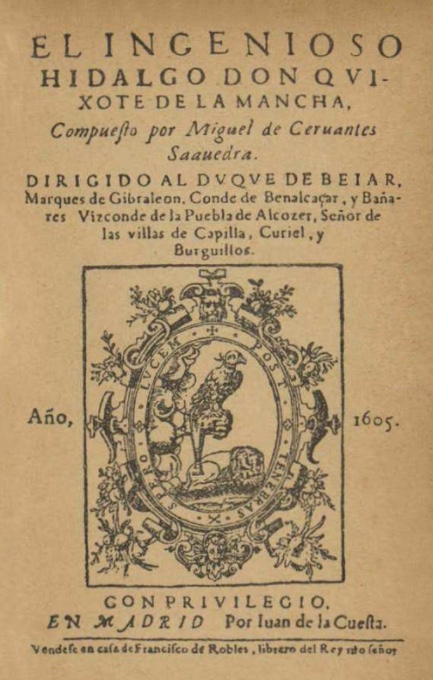
Above: the first edition of Don Quixote.
Curiosities About Cervantes

Despite the fact that we all have an image of what Cervantes looked like, there is no authentic portrait of Don Miguel. Not even the most famous one, attributed to Juan de Jáuregui and housed in the Royal Spanish Academy in Madrid. All the existing images of him, including this one, are artistic representations based—more or less—on the description Cervantes provides of himself in the prologue to his Exemplary Novels.
He Was a Stammerer:
In the same prologue, he acknowledges it with these words: “I will be forced to rely on my tongue, which, though stammering, will not stammer when it comes to speaking the truth.”The ‘One-Handed Man of Lepanto’—But Not Literally:
Although known as “the one-handed man of Lepanto,” he wasn’t actually missing a hand. His left hand was left crippled after the famous battle, but it was never amputated.Excommunicated Three Times:
While working as a tax collector, he was excommunicated three times for attempting to collect taxes from the Church—taxes it was legally obligated to pay.His Family’s ‘Purity of Blood’:
Although some have claimed that Cervantes came from a converso (Jewish convert) family, his grandfather served as a lawyer for the Inquisition. This position required impeccable “limpieza de sangre” (purity of blood), meaning the family could not have had recent Jewish ancestry, or they wouldn’t have been accepted.The True Reason Behind World Book Day:
The 23rd of April is celebrated as World Book Day because of Cervantes, not Shakespeare. Contrary to popular belief, they did not die on the same day in the same year. Cervantes passed away on 23 April 1616, but Shakespeare, using the Gregorian calendar (as we do today), died on 3 May 1616. The confusion arises because England was still using the Julian calendar at the time, while Spain had already adopted the Gregorian calendar.Imprisoned Not Only in Algiers:
In addition to his captivity in Algiers, Cervantes also served time in prison in Spain, largely due to financial and administrative troubles during his work as a tax collector.An Illicit Affair:
Cervantes had an illicit relationship with a married woman, with whom he fathered a daughter. He openly acknowledged the child, despite the social stigma attached to such circumstances in his time.
Spanish or Castilian, a Heritage for All

Miguel de Cervantes wrote his masterpiece in his native language, Castilian. Don Quixote remains one of the most widely read books in history. The ships of the Carrera de Indias carried more than just goods—along with their passage to the Indies, the Spaniards brought their products, customs, and, most importantly, their language.
Today, Spanish is expanding rapidly and is the third most spoken language in the world, after Mandarin and English. Every day, millions of people around the globe speak, think, read, dream, love, and long for things in this language. Without the Carrera de Indias, this would not have been possible.
European and American Grammars
One does not strive to learn and write books about the language of a human group one wishes to exterminate.
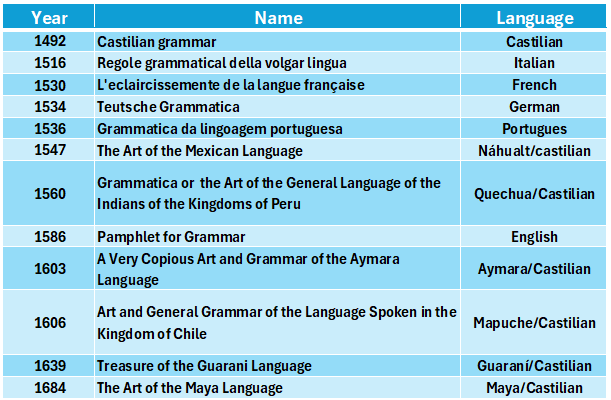
Many of the languages of Native Americans were preserved for posterity thanks to two factors: first, the Spanish continued to allow their use, and second, they compiled their rules in grammars, long before other European countries, such as England, did the same with their own languages.