


The House of Trade

The original headquarters of The House of Trade

The House of Trade in the Royal Alcázar
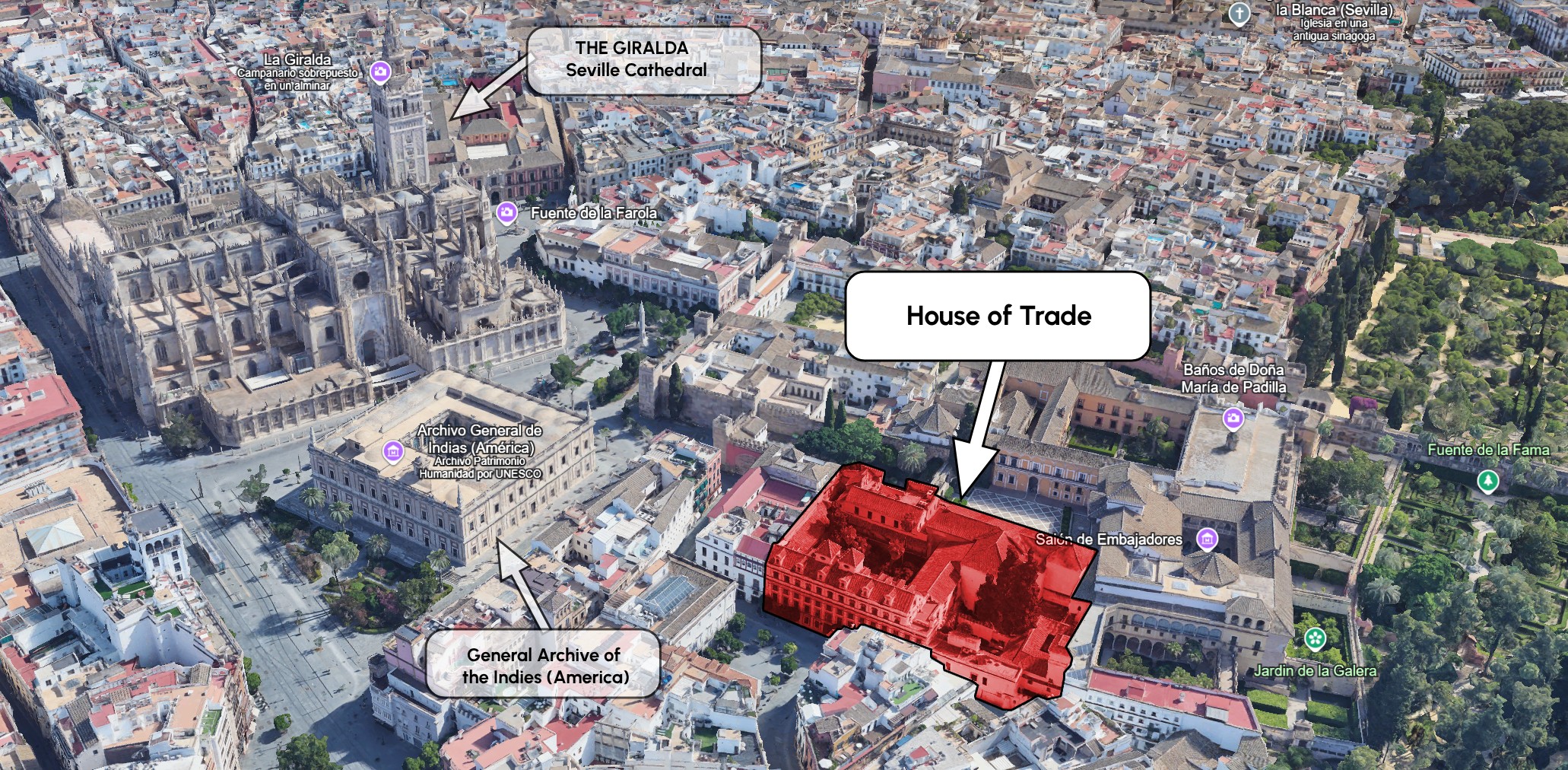
The House was located to the west of Pedro I’s palace, in the area known as the Almirantes district, a “healthy and cheerful” place with a good courtyard and a door facing the river. Between 1503 and 1506, the section of the Admiral’s quarters was demolished and rebuilt with a main facade facing the river. Later, warehouses and houses were constructed in the area of what is now the Plaza de la Contratación.
The main mission of the House of Trade, as described in the chronicles, was: “To gather and keep in it, for as long as necessary, all the goods, supplies, and other equipment needed to provide everything necessary for the trade with the Indies; to send there everything that was needed; to receive all the goods and other things sold from there, everything that was to be sold or sent to be sold and traded to other places where it was necessary.”
Navigation and trade
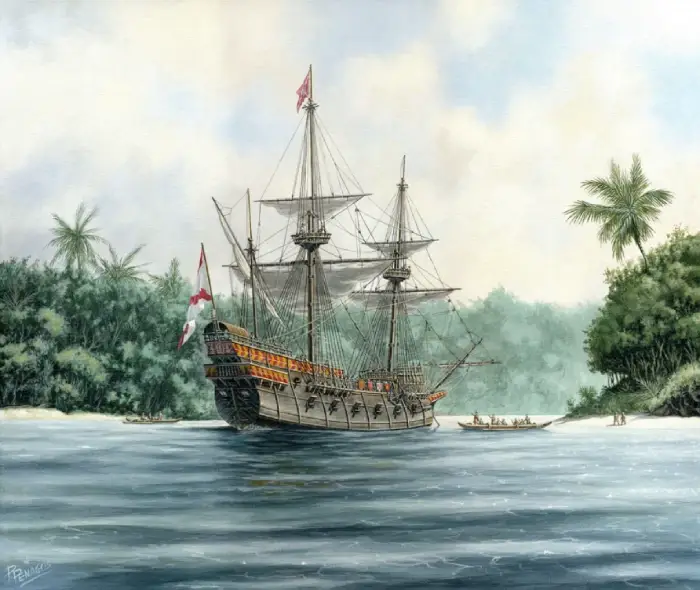
The House was in charge of everything related to navigation and trade with the Indies. Its officers controlled all matters concerning ships, crews, passage, and merchandise.
They registered, inspected, and monitored the merchandise and crews heading to the Indies in the ship registers, and in the same way, they checked that the goods declared in the Indies were the same as those arriving in Seville.
Crew contracts, ship armament, and their navigability and tonnage conditions were inspected by the House, which also set minimum requirements for crew, equipment, and cargo for navigation.
The licences for passage to the Indies.

Only the House of Trade could issue licences for goods, fleets, and passengers, ensuring the purity of blood and the good character of those travelling, deciding who could or could not sail to the Indies.
When the masters loaded their ships, they were required to settle the cargo before the notary. This document was known as the “registro” (register). After loading, the document was presented to the officials of the House of Trade, so they could verify that the information it contained matched their licence books. Once this was done, they would visit the ship again to ensure that no cargo was unregistered and that the limits set were not exceeded. This procedure applied not only on the Peninsula but also in the Indian ports, where the long reach of the House’s authority extended.
The documents in the photo are located in the Casas del Tratado in Tordesillas.

Science and Training at the House of Trade
It was established alongside the Portuguese one as the largest and most important school of navigation and cosmography in the world. It was led by a chief pilot (since 1508), responsible for examining pilots wishing to embark on the career, a cosmographer and chart-making master (1523), and a professor of cosmography (1552).
These positions were held by notable sailors who helped chart the legendary secret map of the Spanish Crown, guarded at the House of Trade: the Padrón Real.
Finally, the official chronicler of the House of Trade wrote the history of the Indies and its technological and scientific development.

Maps, the greatest treasure of the Castilians
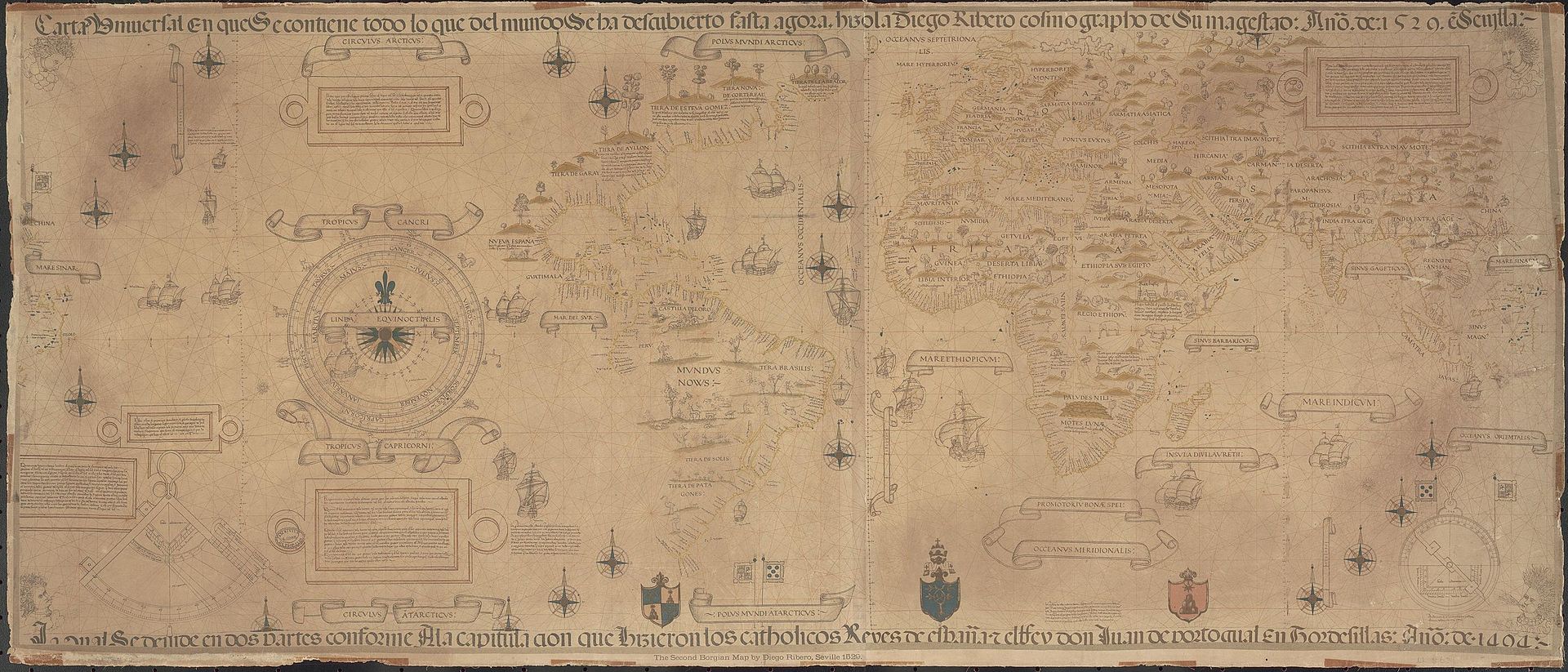
All the mathematicians, cosmologists, astrologers, cartographers, explorers, masters, and pilots who went to the Indies, the true scientists of the time, brought from the new lands the true treasure that sustained the Spanish empire: Their maps.
The House of Trade as a Tax Collector

The House of Trade was the agency responsible for receiving gold, silver, precious stones, etc., corresponding to the royal treasury. It also received the proceeds from the estates of deceased individuals. Regarding taxes and duties, it organised and managed the collection of taxes to fund the Carrera de Indias, including the avería and almojarifazgo taxes.
It was the institution responsible for preparing the ships that transported goods on behalf of the Royal Treasury, and it also managed the sale of items that arrived from the Indies.
Although the aim was to keep trade with the Indies in the hands of the Royal Treasury, this was never fully achieved, and gradually private capital, even from foreign investors, became more involved in the Indian venture. The Crown reserved the exclusive right to deal with certain goods, such as dyes or pearls. Participation in the Carrera was subject to the issuance of a royal licence.
Coordination of associated organizations
The consulate and the university
Two major institutions were part of the commercial framework of the Casa de Indias:
The Consulate of the Indies Merchants: In its early years, merchants gathered and traded in the steps of the cathedral, sometimes even entering the building. The commotion they caused led the chapter to install a chain to mark their jurisdiction, which still remains today. After this, the merchants built the House of Stock Exchange as their headquarters. Today, this building houses the Archivo de Indias.
The University of Sailors (Universidad de Mareantes): An institution that inherited the medieval guild brotherhoods, associating ship owners, pilots, and masters. Initially, its headquarters was in the Triana district, but in the early 17th century, it moved to the Palacio de San Telmo, which now serves as the headquarters of the Junta de Andalucía, as shown in the accompanying image.

The judicial authority of the House of Trade and smuggling

The House had civil and criminal jurisdiction over all lawsuits and cases related to the commerce and navigation of the Indies, as well as everything related to the property of the numerous people who died on the ships of the Carrera de Indias.
The growing number of expeditions undertaken by private individuals meant that legislation had to be enacted to combat a new threat to the royal interests: smuggling. Measures were introduced requiring the masters of ships to avoid making stops on their return journey, particularly in the Canary Islands and especially in the Azores.
Any of these stops could be used to unload smuggled goods and metals to the detriment of the Royal Treasury.
A common excuse used by navigators for these illicit practices was the need to resupply, which led to the rule that, upon leaving the Indies, fleets had to carry enough provisions for eighty days. But there is a difference between regulations and the human condition. Just as life’s course follows one direction, laws evolve in another. As efforts to fight smuggling progressed, a new problem arose.
That of thieves, prompting the House to issue provisions for armament to defend the ships in seas that were beginning to fill with enemies, especially in the “triangle of death” formed by the Canary Islands, the Azores, and Cape Saint Vincent.
The decline of the institution.
1717
In 1728, for the first time in the history of the Casa, the monopoly was broken in favour of the Real Compañía Guipuzcoana de Caracas. Times were changing, and a new type of trade was beginning to emerge.
A few years later, Charles III signed the Free Trade Regulations of 1778, allowing new Spanish ports to open for trade with the Americas, leading to the institution’s suppression in 1790, after nearly three centuries of monopoly.Departure of the fleet to Veracruz, anonymous painting from 1700.
